
NFPA 110 Generator Testing Requirements: Weekly, Monthly, Annual and 36-Month Tests Explained
NFPA 110 requires emergency generators to be inspected weekly and run under load for at least 30 minutes every month, at 30% of nameplate kW or the manufacturer's minimum exhaust temperature. Diesel units that cannot reach that load need an annual load bank test (50% for 30 minutes, then 75% for 60 minutes). Level 1 systems are also tested every 36 months, transfer switches monthly, fuel yearly, and every test is recorded.
In this article
- What is NFPA 110?
- What do Level, Type and Class mean?
- What testing and maintenance does NFPA 110 require?
- How does the monthly generator test work?
- When is an annual load bank test required?
- What is the 36-month test for Level 1 systems?
- What about transfer switches, batteries and fuel?
- What records does NFPA 110 require?
- How to stay NFPA 110 compliant across many sites
- Frequently asked questions
- Sources
NFPA 110, the Standard for Emergency and Standby Power Systems, is the reference most often used for how emergency generators should be installed, tested and maintained. It is written for the United States, but many operators elsewhere use its testing rules as the benchmark for standby power at critical sites.
This guide explains what the standard asks for in practice, from the weekly walk-around to the 36-month test, and how to keep the records that prove it was done.
What is NFPA 110?
NFPA 110 covers the performance of emergency power supply systems (EPSS): the generator, the transfer switches, the controls and everything between the power source and the load terminals. The current edition is 2025.
The standard itself does not decide which buildings need emergency power. Other codes do that, for example NFPA 101 (Life Safety Code), NFPA 99 for health care facilities and the electrical code articles on emergency and legally required standby systems. Those codes point to NFPA 110 for how the system must perform and be maintained. The authority having jurisdiction (AHJ), usually the local fire or building authority, enforces it.
What do Level, Type and Class mean?
Every EPSS under NFPA 110 is classified by three things:
| Term | What it defines | Values |
|---|---|---|
| Level | How critical the load is | Level 1: failure could cause loss of life or serious injury. Level 2: failure is less critical to life and safety |
| Type | Maximum time to restore power after an outage | Type 10 (10 seconds), Type 60, Type 120, Type M (manual), Type O (no interruption) |
| Class | Minimum time the system must run without refuelling | Class 0.083 (5 minutes), 0.25, 2, 6, 48 hours, or Class X (other) |
A hospital's life safety branch, for example, is typically Level 1, Type 10. The Class depends on the fuel the site must hold on hand.
What testing and maintenance does NFPA 110 require?
Chapter 8 sets the routine. The main items:
| Interval | Requirement |
|---|---|
| Weekly | Inspect the EPSS: fuel, oil, coolant, battery and charger, leaks, alarms and general condition |
| Monthly | Run the generator under load for at least 30 minutes, at not less than 30% of nameplate kW or at a load that keeps the manufacturer's minimum exhaust gas temperature |
| Monthly | Operate the automatic transfer switches |
| Annually | Load bank test for diesel units that cannot meet the monthly load: 50% of nameplate kW for 30 minutes, then 75% for 60 minutes |
| Annually | Test the fuel quality using ASTM methods |
| Every 36 months | Level 1 systems: run for the duration of the assigned Class, up to 4 hours |
| Every test | Keep a written record of inspections, tests, exercising, operation and repairs |
Manufacturers' maintenance schedules come on top of this. NFPA 110 asks for maintenance in line with the manufacturer's recommendations, so the oil, filter, coolant and belt intervals in the generator manual are part of compliance too.
How does the monthly generator test work?
The monthly test is the backbone of NFPA 110 compliance. Done properly, it tests the whole chain, not only the engine:
- Start it by simulating a utility failure at the transfer switch, so the start signal, the transfer and the retransfer are tested too.
- Run under load for at least 30 minutes, at 30% of nameplate kW or more, or at a load that reaches the manufacturer's minimum exhaust temperature.
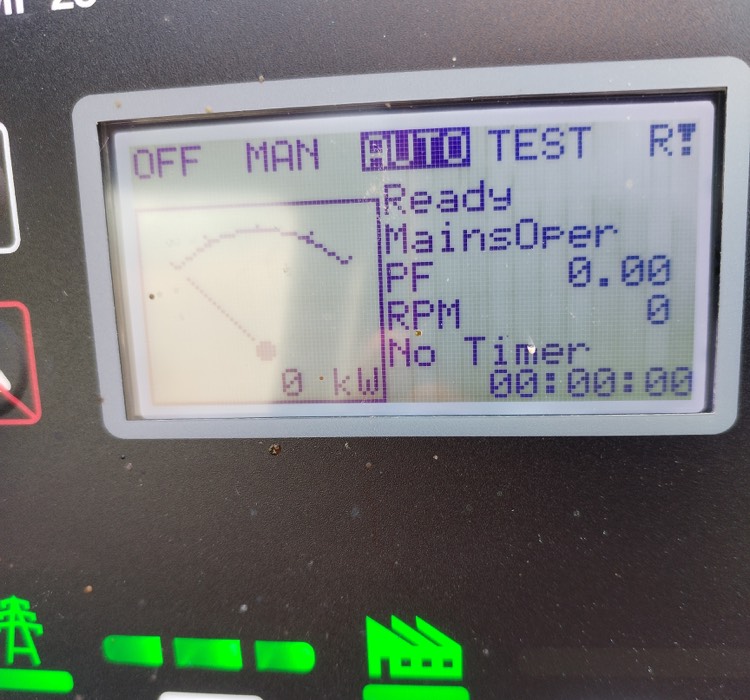
- Record voltage, frequency, load, coolant temperature, oil pressure and any alarms.
- Let the load return to the utility and the generator run its cool-down before it stops.
- Confirm the generator controller and the transfer switch are back in automatic mode.
When is an annual load bank test required?
When a diesel generator cannot meet the monthly requirement with the building's own load, NFPA 110 requires it to be exercised monthly with the load that is available and, once a year, with a supplemental load: in practice a load bank. The minimum profile is 50% of nameplate kW for 30 minutes followed by 75% for 60 minutes, without stopping.
For how the test is run and which readings to record, see our guide to generator load bank testing.
What is the 36-month test for Level 1 systems?
Level 1 systems are tested at least once every 36 months, running continuously for the duration of their assigned Class. Where the Class is longer than 4 hours, the test may end after 4 hours. The test is done with the building load available at the time; where that is too low, a load bank brings the load up. It is the closest thing to a real long outage the system will see on a planned day.
What about transfer switches, batteries and fuel?
- Transfer switches are operated monthly, normally as part of the monthly generator test. Our ATS testing and maintenance guide covers the annual inspection.
- Starting batteries are inspected weekly and maintained as the manufacturer specifies. Battery problems are one of the most common reasons a standby generator fails to start.
- Fuel is tested at least once a year using ASTM methods, and the supply must be kept at the level the system's Class requires. See diesel fuel management.
What records does NFPA 110 require?
A written record of every inspection, test, exercise, operation and repair must be kept on the premises and available to the AHJ. In practice a good record shows:
- date, time and who did the work;
- how the test was started and how long the transfer took;
- load in kW and as a percentage of nameplate, and run time under load;
- voltage, frequency, coolant temperature and oil pressure;
- alarms, findings and what was done about them.
Paper logs work, but they are where compliance usually breaks: missing months, readings filled in afterwards, no load recorded. Readings taken from the controller and stored automatically leave a record nobody has to reconstruct before an inspection.
How to stay NFPA 110 compliant across many sites
- Know the Level, Type and Class of every system, and keep it on the site record.
- Schedule by rule, not memory: weekly, monthly, annual and 36-month tasks generated automatically for each generator.
- Measure the load of every monthly test, so the units that need an annual load bank test are known in advance.
- Capture readings from the controller and a digital checklist, with photos, on the day.
- Turn every failed check into a work order, and close it only when the fix is verified.
Frequently asked questions
How often does NFPA 110 require generator testing?
NFPA 110 requires a weekly inspection and a monthly test under load of at least 30 minutes. Diesel units that cannot reach the monthly load need an annual load bank test, and Level 1 systems need a test at least every 36 months. Transfer switches are operated monthly and fuel is tested yearly.
What is the NFPA 110 monthly load requirement?
The generator must run for at least 30 minutes either at not less than 30% of its nameplate kW rating, or at a load that keeps the exhaust gas temperature at the minimum recommended by the manufacturer.
What is the difference between Level 1 and Level 2 under NFPA 110?
Level 1 systems serve loads where a power failure could result in loss of human life or serious injury, such as life safety systems in hospitals. Level 2 systems serve loads that are less critical to human life and safety. Level 1 systems have stricter requirements, including the 36-month test.
What does Type 10 mean in NFPA 110?
Type 10 means the emergency power system must restore power to the load within 10 seconds of a utility failure. The time includes detecting the failure, starting the engine and transferring the load.
Does NFPA 110 apply outside the United States?
NFPA 110 is a US standard adopted through US codes and enforced by local authorities there. Outside the US it is not law unless a local code or contract adopts it, but many operators, insurers and contracts use its testing rules as the reference for standby generators.
Sources
- NFPA 110, Standard for Emergency and Standby Power Systems, 2025 edition, chapters 4 (classification), 7 (installation and acceptance testing) and 8 (routine maintenance and operational testing).
- NFPA 101, Life Safety Code, and NFPA 99, Health Care Facilities Code, which reference NFPA 110.
- ISO 8528, Reciprocating internal combustion engine driven alternating current generating sets, for generator set performance outside the NFPA framework.
- Related reading: generator load bank testing, generator maintenance schedule and checklist and ATS testing and maintenance.

See every generator's status and service plan in one place
GenSetCare reads alarms, fuel and run hours from the controller, schedules service by run hours and calendar, and gives technicians a field app with live checklists.